
Executives identify business verification and compliance as top priorities for automation
Manila, Philippines — As more Philippine businesses enter the digital economy, financial institutions are facing a balancing act: onboard legitimate merchants faster while maintaining the safeguards needed to manage fraud and compliance risks.
Industry leaders say automation and risk-based verification could help achieve both.
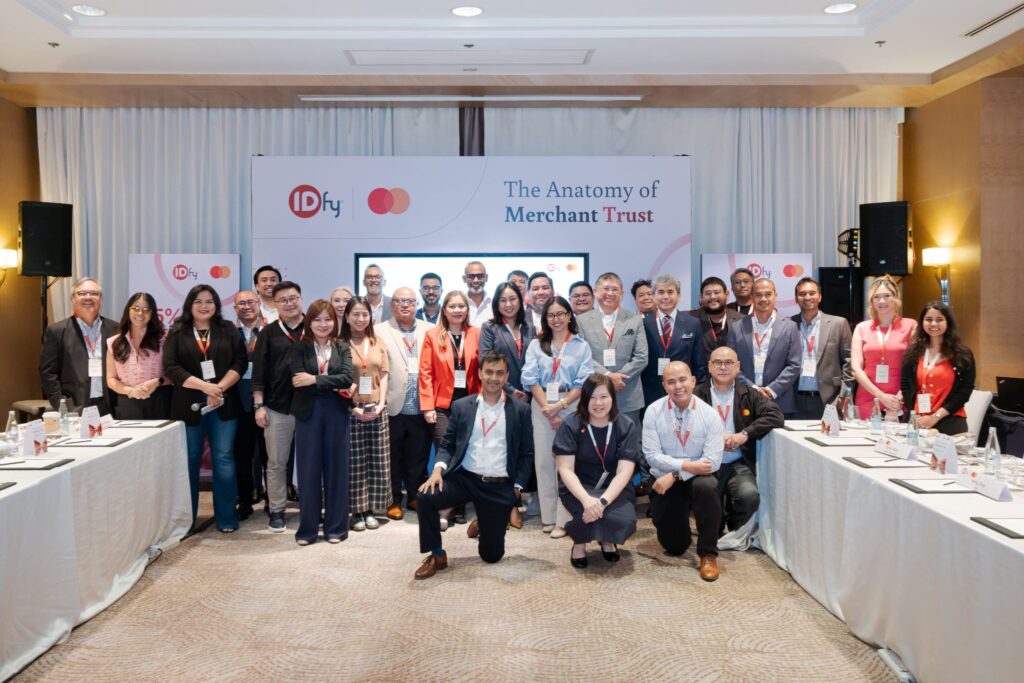
The topic was discussed at The Anatomy of Merchant Trust, an executive roundtable co-hosted by IDfy and Mastercard in Manila, where banking, fintech and payments leaders examined how technology can improve merchant onboarding and strengthen trust across the financial ecosystem.
Digital payment adoption is already accelerating. Bangko Sentral ng Pilipinas (BSP) data shows that QR Ph adoption has surpassed 57 percent, reflecting the growing role of digital payment channels in everyday transactions.
However, the infrastructure used to onboard merchants has not always evolved at the same pace.
For many micro and small businesses, verification remains fragmented, with processes often relying on paper documentation, manual checks and physical audits. These requirements can be particularly difficult for merchants operating with limited resources.
At the same time, incomplete or difficult-to-verify business information can increase uncertainty for financial institutions. In response, institutions may apply blanket risk controls that inadvertently make it harder for legitimate businesses to access digital financial services.
Automation could help address both sides of the challenge.
By applying automated, risk-based verification, institutions can streamline business checks while maintaining the ability to identify higher-risk cases that require additional review.
Internal polling conducted during the roundtable reinforced the opportunity. Business document verification and compliance checks received the highest score among workflows identified for automation, at 4.4 out of 5.
The opportunity is particularly relevant as government programs continue to bring more small businesses into the digital economy. Initiatives such as the DTI’s Tindahan Mo, e-Level Up Mo! have helped thousands of merchants gain digital literacy and access cashless payment tools.
Efficient onboarding can help ensure that these businesses are not left at the edge of the formal financial system once they become digitally enabled.
“Merchant trust is no longer a one-time verification exercise—it is a continuous lifecycle,” said Raghuraman Chandrashekhar, PH Country Head of IDfy. “As digital payments scale across the Philippines, institutions must move away from fragmented onboarding and adopt intelligent, risk-based systems that unify identity verification, alternative data, and real-time monitoring. The future of financial inclusion depends on enabling MSMEs to be onboarded quickly and safely at scale.”
Automation must also extend beyond the onboarding stage.
As fraud becomes more sophisticated, continuous monitoring can help institutions detect document forgery, deepfakes and suspicious post-approval activity. Real-time behavioral analytics can provide an additional layer of protection without subjecting legitimate merchants to unnecessary checks.
Better verification can also support more informed credit decisions. Alternative data—including digital payment records, utility payments and transaction footprints—can provide additional signals for assessing businesses with limited traditional credit histories.
When combined with progressive lending models, these approaches could potentially unlock formal financing for more than one million underserved merchants nationwide.
“Merchant trust extends well beyond onboarding. As more businesses participate in the digital economy, the industry needs to strengthen collaboration across banks, payment providers, fintechs, and technology stakeholders,” said Jason Crasto, Mastercard’s Country Manager for the Philippines. “Each stakeholder brings unique capabilities, perspectives, and expertise to the table. Through stronger public-private collaboration, shared intelligence, and advanced risk solutions, we can build a more secure, scalable, and inclusive digital ecosystem that empowers Philippine MSMEs to grow with confidence.”
For the financial sector, the opportunity is clear: use automation not simply to make onboarding faster, but to make it more intelligent, consistent and inclusive.
For more information on the roundtable discussion, you may visit www.idfy.ph.